Go Back And Get It: The U.S. South At The Center of Change
“So goes the South, so goes the Nation.”
More than a regional saying, this guiding theme of the 2026 SAFSF Forum served as both a historical reflection and a call to action brought into the space by Ms. Carol Blackmon, Fund Advisor, Southern Black Farmers Community Led Fund, and other speakers. The South has long been a bellwether for the nation’s future. The systems that take root there, whether systems of exclusion or liberation, have shaped the trajectory of the entire country. What goes unaddressed in the South, particularly persistent racial and economic inequities, rarely stays in the South.
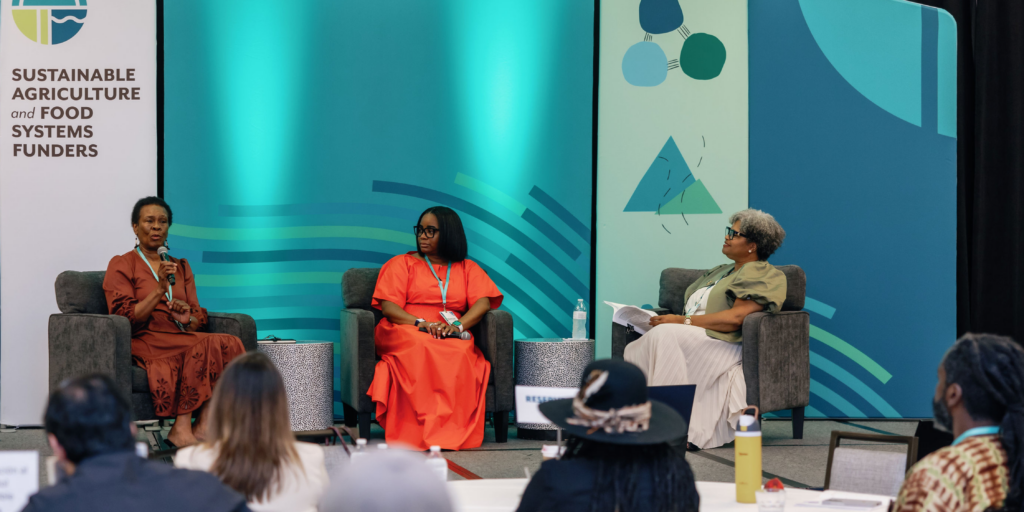
Pictured above: Ms. Carol Blackmon (left), Seanicaa Edwards Herron, and Dr. Veronica Womack
That reality makes the region central to the future of America’s food system.
Home to 39 percent of the U.S. population and nearly 300 persistently impoverished counties, representing roughly 80 percent of the nation’s total, the South also holds extraordinary agricultural assets. Its fertile landscapes, deep Indigenous and Black agricultural traditions, diverse production systems, and growing importance as climate change reshapes where food can be produced position the region as essential to the nation’s future food security.
Yet despite its importance, the South remains chronically underfunded by both public and private sectors. Seanicaa Edwards Herron, Executive Director, Freedmen Heirs Foundation, said it best: “In this environment, funders are making decisions based on fear and what retribution would look like if you continued on the path that started five years ago. That path being: we want to work with you, we want to support your work, we’re going to double down and stand with you. That same magnitude of support has dissipated tremendously, and it’s not fair to the communities in the South.”

Hosting this year’s SAFSF Forum in the South was intentional and strategic, inviting funders to deepen relationships with communities that have long been driving innovation with far fewer resources. Civil rights icon and farmer, Ms. Shirley Miller Sherrod, Executive Director, Southwest Georgia Project for Community Education and Co-Founder & Executive Director of the Sherrod Institute, challenged attendees to see the South not through the lens of deficit, but as a place rich with solutions, resilience, and wisdom earned through generations of perseverance. The work ahead is not to invent something entirely new, but to recognize, invest in, and follow the leadership that has long existed and continued to adapt to changing conditions.
Living legends like Ms. Sherrod and ancestors before her have provided a blueprint and can assist us in continuing our agrarian legacies and traditions.
Reimagining our “ancestral futures” the SAFSF Forum theme, rests on drawing lessons of the past and creating with intention the world we hope to leave to the next generation. If the South has historically foreshadowed America’s greatest challenges, it can also illuminate its greatest possibilities. Investing in the people, communities, and movements already leading in the South is not simply a regional strategy. It is an investment in the future of the nation’s food system, democracy, and shared prosperity.
Defending Democracy Through State Leadership
in Food and Agriculture
Against a backdrop of unprecedented federal funding volatility, including EPA and USDA grant rescissions, the cancellation of the Local Food Purchase Assistance (LFPA) program, SNAP cuts, and other threats to public infrastructure that supports food systems, it is unmistakable that the center of gravity is shifting toward state and local policy. A lunchtime plenary organized by State Innovation Exchange (SiX) brought together a panel of Southeastern state legislators who are advancing food systems policy while defending democratic institutions. As Kendra Kimbirauskas, Senior Director at SiX, reminded attendees, state legislators are “often the last line of defense against threats to our democracy and personal freedoms.”

Pictured above: Kendra Kimbirauskas (left), Rep. Eric Ager, Sen. Hillman Frazier, and Rep. Justin Jones.
For North Carolina State Representative Eric Ager, Mississippi State Senator Hillman Frazier, and Tennessee State Representative Justin Jones, working on regenerative agriculture and food justice is inseparable from protecting multi-racial democracy and building community power.
This discussion took on added urgency given the ongoing erosion of Black voting rights. Reflecting on the implications of the Supreme Court’s ruling in Louisiana v. Callais that gutted the Voting Rights Act, Representative Jones warned, “We are facing a reality that if we do not act, it will be the largest loss of Black Political representation since the end of Reconstruction.” The panel collectively made the case that weakening democratic representation also weakens the ability to advance the policies needed for a more just, climate-resilient, and equitable food system.
Despite these challenges, these legislators are not backing down; instead, they are using their positions, particularly on agriculture committees, to bring urban and rural communities together around shared concerns such as corporate consolidation, economic opportunity, and community health.“We have to have a united front [across the] United States to take on this new Confederacy,” said Representative Jones, “Because if we have any hope of passing all the policies, the brilliant ideas that come up in this conference, we have to have legislatures that are responsive.”
To build this united front, state representatives are engaging directly with coalitions, partnering with unusual and non-partisan allies, lifting up common struggles, and getting young folks excited about running for office, with the support of organizations like SiX. Longtime Mississippi state Senator Hillman Frazier emphasized, “We have to build coalitions because we know that we’re going to have common interests going forward. We have to build on those relationships.” Representative Ager echoed that sentiment from another angle, arguing that “the best way to beat corporate power is with constituent power.”
The conversation also highlighted the practical challenges of state governance. Legislators are frequently asked to make consequential decisions with limited staff, constrained budgets, no or low salaries, and uneven access to independent research. Organizations like SiX help fill that gap by providing legislators with credible, nonpartisan policy analysis and connecting them with experts beyond traditional industry voices (namely, Farm Bureau), enabling more informed decision-making on food, agriculture, and rural policy.
Senator Frazier closed with a direct invitation to philanthropy: “In order to get to the goal line, we need credible research and information, and that’s where the funders can come in, funding [organizations that] can provide us with the resources we need to make the fight for you.”
For funders, the implications are clear. Investing in state-level policy infrastructure, independent research, knowledge-sharing networks, and grassroots advocacy advances better food policy and will strengthen the democratic capacity needed to build resilient food systems from the ground up.
By Land And Sea: Fisheries and Our Climate Future
From climate-focused workshops to immersive field days, one theme surfaced again and again: our food future depends on treating land and water as interconnected systems. Conversations throughout the SAFSF Forum explored how climate change, pesticides and PFAS contamination, energy sovereignty, data center expansion and rural development, farmland access and land loss, Tribal sovereignty, market access for sustainable seafood and agriculture are not separate issues. Woven together, these issues underlie the resiliency of food systems that nourish both people and the planet.
In her keynote address, Niaz Dorry, Coordinating Director, North American Marine Alliance, drew a powerful connection between land and sea when she stated that the same forces of corporate consolidation, privatization, and industrialization that transformed agriculture are now reshaping fisheries. Fortunately, a growing movement of Black, Indigenous, immigrant, and small-scale fishing communities and enterprises are advancing a different vision: one rooted in stewardship, local ownership, cultural knowledge, and community wellbeing. Their work demonstrates that climate resilience depends not only on protecting ecosystems, but also on ensuring the people who steward them can thrive.

“There is a way to do aquaculture with values as well. Aquaculture is not a new thing. The Blue Revolution isn’t teaching us something new. Aquaculture has been around Indigenous communities for millennia. We’ve just decided that we’re going to industrialize that process too and give it a new name and pretend like we’re saving the world with it,” Dorry cautioned.
Several Field Day events in the Gullah Geechee Cultural Heritage Corridor reinforced that healthy food systems are inseparable from cultural preservation. Through sacred ceremonies and storytelling, Queen Quet, the Chieftess of the Gullah Geechee Nation, and others shared with Forum attendees how generations of Gullah Geechee communities have led ecological conservation of coastal landscapes through sustainable fishing and cultural preservation of traditional practices, though these practices are now threatened by rising sea levels.
Throughout the Forum, Native leaders similarly emphasized that Tribal sovereignty and Indigenous stewardship are foundational to long-term food security and community wellbeing in light of climate disruption. From fisheries and forests to farmland and rangelands, Indigenous-led approaches demonstrate that caring for ecosystems, strengthening local economies, and honoring cultural traditions are mutually reinforcing goals rather than competing priorities.
The challenges facing sustainable fishing communities mirror those confronting land-based producers and food workers across the country. Limited market access, inequitable leasing policies, competition from industrial-scale production, and unsafe labor conditions continue to threaten community-based seafood systems. As Dorry observed, “Whether working on the deck of the boat or the floor of a factory, fish workers, [and] seafood workers have the same struggle as land food workers do. From sexual harassment to wage theft to immigration rates to unsafe working conditions, they have the same struggles.” Achieving a just climate transition in food systems requires centering workers and independent producers on both land and sea.
The Food System Belongs To Those Who Work The Land:
Defending Food Chain and Farm Workers
The U.S. food system structurally relies on the exploitation of workers, many of them immigrants. There are approximately 2.6 million reported direct on-farm workers in the U.S., with an estimated 2.9 million total agricultural workers when including seasonal labor. Additionally, the broader agricultural and food sectors support over 22 million jobs, representing 10.4% of total U.S. employment. “The people are not only the backbone, we often hear about that, but also the central hearts and minds of the food system with incredible skills and talent, and contributions to our communities as well,” says Ann Thrupp, Senior Program Officer, Clif Family Foundation.
Despite the vital role they play, farm and food chain workers disproportionately face economic, environmental, and health injustices, and are vulnerable to political violence and often lack equitable legal protection. Compounding this, food chain workers and organizations representing their interests are often excluded from policy conversations and funding consideration. “We’ve been subpoenaed…We’ve been harassed. We’ve had guns pulled on us,” shared Leticia Zavala, Organizer, El Futuro Es Nuestro. “Recently, there’s [been] more police activity on the farm since last year, threatening workers with deportation, even though they’re here on [H2A] visas.” Despite the risk, organizers like Zavala are in it for the long haul. When introducing this panel of incredible women activists, moderator Veronica Garibay, Co-Executive Director, Leadership Counsel for Justice and Accountability, said: “They’re not birds of passage that come and go; they stay rooted in the community, working and standing alongside their neighbors, fighting for justice.”
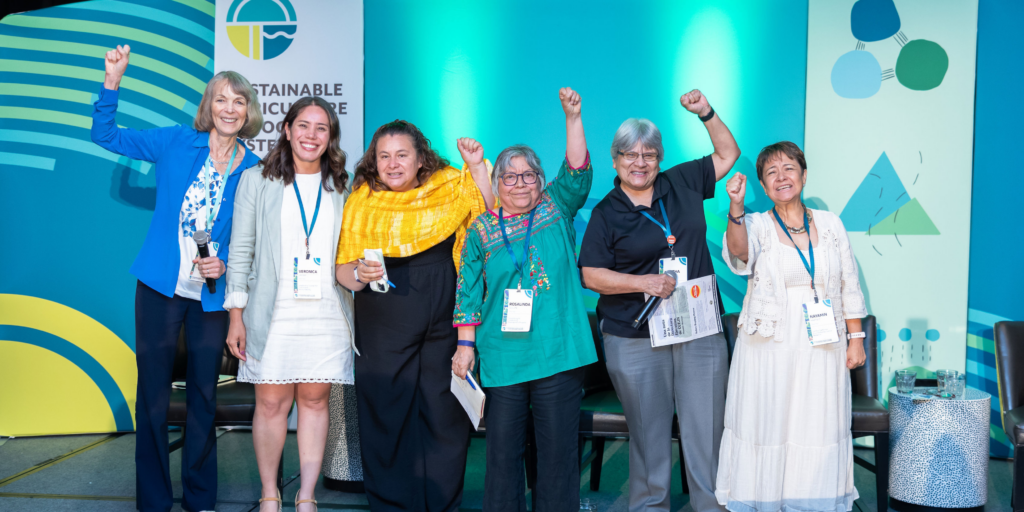
Pictured above: Ann Thrupp (left), Veronica Garibay, Leticia Zavala, Rosalinda Guillen, Martha Ojeda, and Nayamin Martinez
In closing, speakers chanted Dolores Huerta’s famous words, “¡Sí se puede!” or “Yes, we can”—the perfect closing reminder of our bond and responsibility to one another.
A Future Food System For All: Coordinating Investments,
Changing Markets, Building Power
The SAFSF Forum demonstrated clearly that community-led solutions and agricultural innovation are abundant. The challenge that regenerative producers, community leaders, and social innovators still face is limited and uncoordinated capital for long-term social and economic transformation. Several Forum sessions sketched a roadmap to close these gaps, offering funders guidance for blending funding, coordinating investments, and shifting funding practices for greater systems impact.
To support regenerative and sustainable farmers, funders must wrestle with the complex business and market dynamics that producers face. In one case, Dirt Capital Partners (impact investment fund), Foodshed Capital (CDFI), The Conservation Fund (regranting organization), and Walton Personal Philanthropy Group (part of a family office) worked alongside BIPOC-led producers Deer Creek Farm in Covington, Georgia, and Dodo Farms in Mount Airy, Maryland to provide flexible grants and investment capital for structural business needs. Working hand-in-hand as diverse capital providers, coordinated investments addressed business growth needs, land access support, and even local policy change, reflecting a holistic, flexible, and “farmer-first” approach to regional food systems. The key to their collective success – and the group’s guidance to other funders – was that the funders absorb and share risk with the farmer as they transition to more sustainable practices.

Coordinated investments that leverage public financing can also unlock market transformation at scale for regenerative, BIPOC, and localized producers and the communities they serve. One Forum session reviewed the lasting impact of the now terminated federal programs, the Local Food Purchase Cooperative Agreement Program (LFPA), and the Local Food for Schools Program (LFS). Combined, these programs invested $2.2 billion over three years, driving resources to small and mid-sized farms and food hubs to scale their operations and access stable market opportunities, all while delivering fresh, culturally appropriate food to local communities. Bipartisan support in Congress remains for these programs, but new momentum is growing at the state level as well. For example, California just included $15M in the state budget to continue funding LFPA, and the New York State Legislature just sent the Good Food NY Bill to Governor Hochul’s desk for signature. Changing institutional procurement at schools, hospitals, and senior meals programs in the public sector presents an incredible opportunity to shift markets in support of local and sustainable farming, improve working conditions across the supply chain, and improve the nutrition and health of the people who rely on these food programs.
Coordinating investment and changing markets are only two pieces of the puzzle, however. Systems change can only be achieved and sustained through powerful advocacy and movements that can shift policy and change institutions. Leaders at National Sustainable Agriculture Coalition, National Young Farmers Coalition, and Illinois Stewardship Alliance explored how building a broader, more unified and organized base, strengthening movement infrastructure, and expanding the capacity to govern, not just resist, will prepare us for 2029 and beyond. For funders, this means resourcing leaders to build bridges across differences and needs, supporting coalitions to grow relationships and networks, and funding organizations to engage in policy advocacy at every level using every lever. Liberating Investment in the Food and Farm Ecosystem (LIFE) held a session focused on how to address systemic barriers preventing frontline and movement-led organizations from accessing philanthropic funding and strategies to create more equitable investment opportunities. This includes increasing collaboration between community-based and movement organizations, foundation leadership, founding families, and governing boards to establish shared priorities.
Being Good Ancestors: Meeting The Generational Moment
The Forum closed with a grounding meditation on the power of origin stories as a place for creating change. A sommelier by training, Stephen Satterfield was taught to investigate the environmental factors that shape the grapes of wine. Now a storyteller and Host of Netflix’s series High on the Hog, Satterfield translated this same concept in terms of food systems change as “provenance,” or understanding the origins and place from which something comes. When it comes to an extractive, environmentally unsustainable, and unequal food system, he encouraged us all to consider the provenance of how we got here. The commodification of food, he argued, is the epitome of erasing or invisibilizing provenance. “Most of our food is a commodity that is faceless and placeless. And that is very much part of the design of our food system,” said Satterfield. “It’s the system that we all inherited. It’s a system that was perfected on the plantation. And it is the system that will continue to strangle us all until we can identify it, name it, and break it.”

Making visible the “provenance” of the challenges we face in our food system – from environmental impact to social injustice – is part of the solution for Satterfield. “The work is really about bringing ourselves and our stories back into an environment of legibility after centuries where our presence was capitalized on but was never acknowledged…Legibility in an environment of erasure is actually the tip of the spear. It’s our most formidable weapon.”
Legibility is not just stories about where food comes from, but also storytelling the truth about why we have an unsustainable and unequal food system in the first place. Satterfield invites us to think like a sommelier when exploring the system we inherited: “…like [a] sommelier’s understanding [of] the nature of the environmental factors that inform what the wine tastes like, I believe [that understanding] can be extrapolated into the work that you all are doing by simply asking the question of where did this begin? How many times have you asked yourself in the work that you’re doing, not what the purpose is, but what the provenance is? What is the origin of the problem you’re trying to solve?” This is what Satterfield himself seeks to do in building his new brand, COMOCO Cotton, where he is “bringing provenance to Black farmers growing cotton in the U.S. South and bringing that value through legibility, through traceability, all the way to the consumer.”
Closing his keynote address, Satterfield reminded us that our stories hold power to dismantle generational lies and historical amnesia, and bring a new truth to the food system we inherited. “With food, assuming that we do have choice and we do have access, it becomes a matter of culture, of identity, of heritage, of ancestry, and a unique tool to connect each and every one of us.”
Following the keynote, Satterfield was joined by two icons for a conversation focused on the origins of their work through the lens of this current moment.
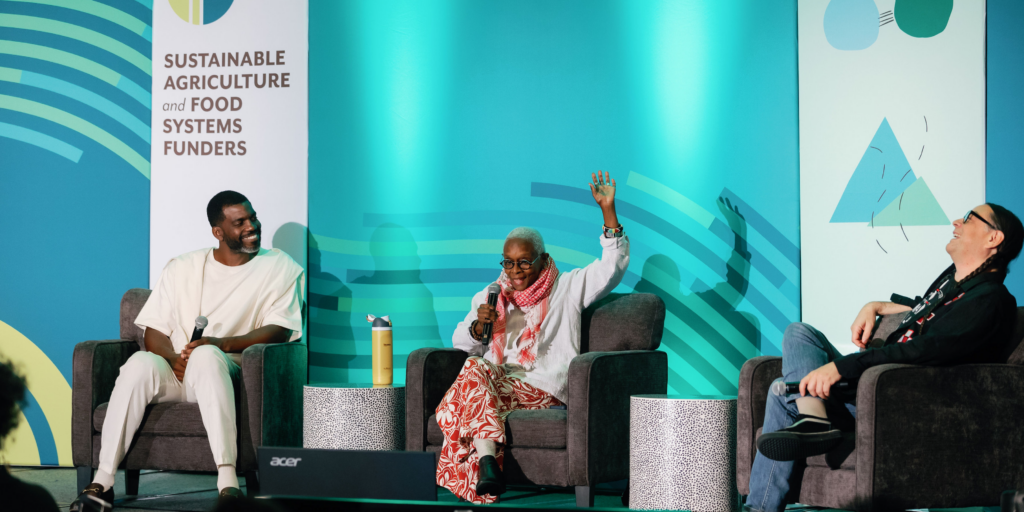
Pictured above: Stephen Satterfield (left), Konda Mason, and Sean Sherman
Konda Mason, Co-Founder of Jubilee Justice and Potlikker Capital, shared her journey from Oakland to living on and owning a former plantation in Louisiana where she now grows regenerative rice. She traced her heritage to the Sierra Leonean people who were enslaved by Europeans for their mastery of growing rice. Mason said, “[The plantation owners] didn’t know how to grow rice, and they intentionally enslaved these rice growers because they needed the food, and they wanted to import that knowledge to this new land.” When it came to the stewardship of her rice farm in Louisiana, Mason said, “I knew it was clearly ancestral.” Through Jubilee Justice, she is forging a new path of ownership that honors her heritage out loud, combating erasure through reclamation. Mason shares, “We’re reclaiming rice as our food ways, African food ways, and our origin story is rice.”
Growing up on South Dakota’s Pine Ridge Reservation, Sean Sherman, Chef of Indígena by Owamni and Executive Director of North American Traditional Indigenous Food Systems (NATIFS), did not have access to traditional Lakota foods: “I was a product of a lot of FDPIR (Food Distribution Program on Indian Reservations) and commodity food programs.” As Sherman began his culinary career, he came to question the Eurocentricity in culinary education and the broader food system. Living with the Huicol people in Mexico, he was drawn to reclaim what had been lost: “Their indigeneity and what I experienced growing up around Lakota people was just a different connection to the Earth, to the plants we use, to the animals, and there was just kind of this symbiotic approach to understanding the life and the world around us.”
Sherman’s realization launched his passion to revitalize Lakota food heritage in his restaurants by first stripping out every colonial-era ingredient (wheat, dairy, cane sugar, beef, pork, chicken) and then by rebuilding a regional, Indigenous food system. After the success of his first restaurant in Minneapolis, Sherman recently opened Indígena by Owamni, the largest Indigenous-focused restaurant in America— a 200-seat space that just opened with 140 employees, turning food into both cultural reclamation and a genuine engine of job creation for Indigenous people and people of color. The restaurant is an economic engine for Indigenous producers across the world. “And that’s where the power is, because that’s a big step of food sovereignty—strengthening our producers, giving them the access to be able to sell.” Sherman’s latest venture is in institutional food service through Meals for Native Institutions, a co-packing model supplying scratch-made meals to large institutions like schools, hospitals, penitentiaries. Like Mason, the key is community ownership of food infrastructure rooted in traditional, ecological and Indigenous values.
Satterfield, Mason and Sherman spoke to a future rooted in the reclaiming of ancestral knowledge in a time where our nation is divided. They encouraged us to do the work of building unity across divides — including with political and cultural opposites. “It’s not black and white or blue and red,” shared Mason, “There’s this really juicy middle that if we knew how to do it, we could win.” Sherman quickly followed with “I feel like that middle is humanity.” For these food system leaders, there is hope: “We can reimagine a new world,“ said Mason, “We can reimagine another way of looking at life, all life, and centering all life [by] opening up our circles of care beyond ourselves and our families.”
FORUM GALLERY
Experience key moments from the 2026 SAFSF Forum through our online photo gallery. When using images from this gallery, please credit them with the tagline: Photo by Ale Santana • 2026 SAFSF Forum. If you have additional photos from the SAFSF Forum, please email them to [email protected].


SPONSOR THANK YOU
We are so grateful for our 2026 SAFSF Forum sponsors whose support amplified the voices of movement leaders and peers working at the intersection of food systems, health, equity, climate, and economic development. Thank you again for your contributions that made this Forum one to remember. We extend a special thank you to our Sustainer level sponsors: Clif Family Foundation, The Kresge Foundation, and Martha and Hunter Grubb Foundation for their generous support. Learn more about all our sponsors here.
STAY CONNECTED
Subscribe to our newsletter and follow us on LinkedIn to stay in the loop and receive updates straight to your inbox. Our next SAFSF Forum will be held in 2028. In the interim, keep an eye out for ways to partner on upcoming regional events in 2027.