
Digging In Discussion Guide
Digging In documents the story of American agriculture in its totality, unearthing complexities in the food system in land access, consolidation, and climate change. The narrative follows Masika Henson, an environmental advocate turned guide, from the plains of North Dakota to a celebration in Nicodemus, Kansas, to central Missouri and the Rosebud Indian Reservation in South Dakota, to the West Coast, as she unpacks the food system. Follow Masika as she digs in to answer the question: is there hope for our food system?
What makes Digging In a truly unique film is the way it takes on complex but powerful forces in our food system in an easy to digest format. The film explores themes of land ownership and corporate control, the hollowing out of rural America and the devastating impacts of a changing climate on farming communities. The film also highlights the struggles many marginalized farmers face, such as legacy Black farmers in Nicodemus, Kansas who struggle to maintain land due to financial difficulties and lack of support. Viewers also learn about the impact of market concentration and land consolidation, where large farms and processors dominate, leading to economic pressure on small farmers and local communities. Additionally, the conversation touches on the role of policy, particularly the Farm Bill, in shaping the agricultural landscape and the need for reform to support sustainable and equitable farming practices.
SCREEN DIGGING IN
Digging In is available to you – now with a robust resource and discussion guide – to elevate the stories and situations featured in the documentary as sparks for systemic change that funders, nonprofit organizations, farmers and ranchers, and policymakers can work toward together. Land, corporate power, and climate change – these are three complex topics now made accessible. Let’s dig in.
For over 20 years, SAFSF has been the leading national membership organization for philanthropy and impact investors committed to creating an equitable and sustainable food and agriculture system. Our network of 120+ members includes foundations, impact investors, community development finance institutions (CDFIs), funding collaboratives, and regranting organizations.
Sustainable Agriculture and Food Systems Funders, in partnership with Nathan.Works, produced Digging In in 2022, with underwriting provided by Vatheuer Family Foundation.


HOW TO USE THIS GUIDE
Diggin In stands out among other food documentaries because it tackles complex topics by introducing the viewer to memorable people and places, bringing to life the issues they face within the broader food and agriculture system in a way that is accessible and thought provoking. This discussion guide is designed to support groups who are learning about food and agriculture by unpacking the themes of the film and promoting further discussion. We created this film to shed light on under-discussed topics and under-resourced communities who face challenges but also offer solutions at the margins of our current food system. Additionally, SAFSF produced a series of virtual “lunch and learn” events that feature leaders in the field who weigh in on themes and scenes of the film. These 45 minute recordings are also linked in the discussion guide below.
While we hope this film will influence philanthropy to better understand the needs of marginalized producers and communities, we believe that Digging In is a useful tool for diverse audiences and ages. The documentary and accompanying discussion guide are in no way exhaustive, and we encourage you to continue learning by clicking the links for the dozens of organizations and people featured in this production. We hope this discussion guide will deepen your understanding of people and places, the policies and market forces that bring food to our plates – and inspire you to take action in your community for a more sustainable and just future of food.
KEY THEMES
The vision of SAFSF is that all resources invested in food and agriculture systems enhance our collective well-being. Each of the three issues we address in Digging In – consolidation and concentration, land access, and climate change – presents a complex series of challenges to achieving this vision. We’ve developed a guide for each film section to help you explore one or all of these topics in greater depth. The complete discussion guide is also available for download here.
DIG INTO THE FILM
Is there hope for our food system?
When we set out to create Digging In, we hope to make a film about food – and we finished with more questions than answers. The answers we did encounter changed our minds, lifestyles, and approach to food in the United States. The film shows where our food system is abundantly failing, but also shows that change is possible. The good news is that the farmers and experts, communities and advocates featured in the film are leading on solutions. A more resilient local regional food system is being created as we speak, and with increase resources and support, change is possible in our lifetimes.
DIGGING DEEPER
A few more opportunities to learn with featured leaders and advisors to the film.
- Livestock and Poultry Concentration with Open Markets Institute (August 29, 2024) – covering USDA’s New Fair and Competitive Livestock and Poultry Markets Proposed Rule, state of livestock and poultry industry, and food policy.
- Climate Change with Practical Farmers of Iowa (October 16, 2024) – farmland viability, beginning farmers, and land acquisition
- Climate Change with FoodWhat?! (October 2, 2024) – philanthropy as a tool to combat climate change, ancestral foodways, and seed stewardship
Additional Discussion Questions
- One of the co-producers of Digging In, Jay Austin, noted that filming gave him more empathy and understanding toward food producers in rural America. Reflect on your perspective on rural America, including Tribal and Indigenous communities and rural producers before and after the film. Did you learn anything that surprised you?
- During the buffalo hunting process at Wolakota Buffalo Range, TJ Heinert describes the relationship between the hunter and the animal, naming buffalos as relatives and the harvest as a sacred rite. In what ways do you feel connected to (or not connected to) the animals you consume?
- Review the definition of “food sovereignty.” What is a food that is culturally significant and relevant to you? To your family? To your community? Do you feel that you have control over the foods that mean the most to you? Why or why not?
ABOUT THE FILM
Featured Individuals— in order of appearance
- TJ Heinert, Assistant Range Manager, Wolakota Buffalo Range
- Masika Henson, Narrator
- Dr. JohnElla Holmes, Executive Director, Kansas Black Farmers Association
- Lateef Dowdell, Descendant and Land Owner in Nicodemus, KS
- Jillian Waln, Marketing Director, Sicangu Co.
- Dãnia Davy, Executive Director, Federation of Southern Cooperatives
- Bertha Magaña, Owner of Magaña Farms
- Wes Shoemyer, Owner of Shoemyer Family Farms and Former Senator, Missouri
- Joe Maxwell, President of Farm Action, Former Lt. Gov, Missouri
- Ferd Hoefner, Farm Policy Consultant, Washington, DC
- Claire Kelloway, Program Manager for Food and Agriculture Systems, Open Markets Institute
- Webster Davis, Owner of Triple D Produce, Chairman of Missouri NAACP Agriculture Committee
- Dr. TJ Cooper, Farmer in Fulton, Missouri
- Bill Bullard, CEO, R-CALF USA
- Donal Knipp, Former Owner of Knipp’s Market in Auxvasse, Missouri
- Chance Weston, Food Sovereignty Director, Thunder Valley CDC
Locations
NARRATIVE FILM PRODUCTION
Led by Nathan.Works, film production responded to and was accountable to the communities visited. Imperfectly, we practiced the following throughout the production:
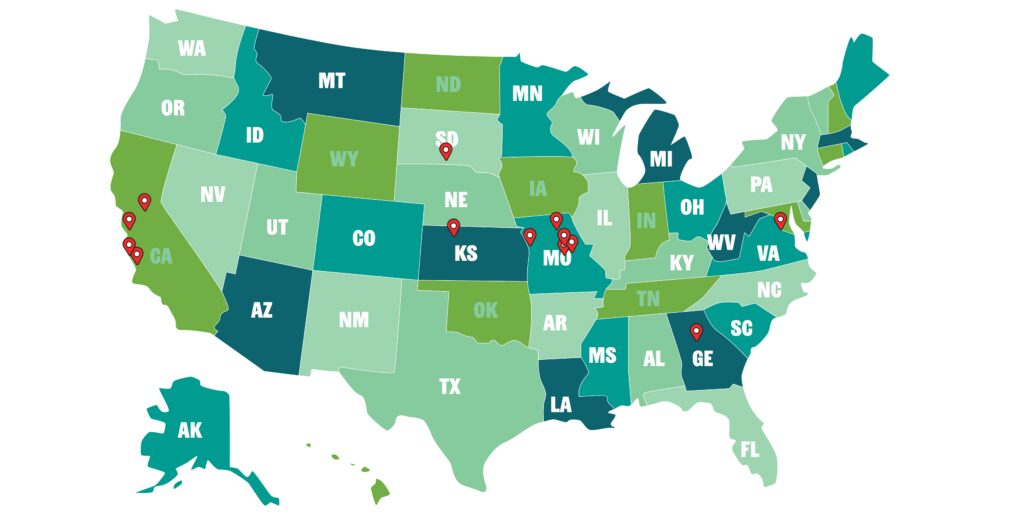
- Chose locations closer to our crew’s homes in the Midwest, High Plains, and the Bay Area
- Opted for road trips over flying when possible
- Planned efficient productions with limited movements between set-to-set
- Materially limited our plastic and paper usage
- Avoided chain restaurants and sought out local eateries that sourced food as responsibly as possible
- At the end of our production, we calculated our CO2 emissions and paid for carbon offsets that went to soil health initiatives. We know that legitimate carbon offset programs aren’t easy to find, and we also acknowledge how purchasing offsets can easily lead to more behavior that produces emissions. This is why we focused on rethinking and reducing throughout the project more than offsetting.
We are advocates for a future where making a film about Mother Earth is regenerative, sustainable, non-extractive, and kind, and we understand our role in bringing about that future.

Nathan Lee Johnson
Nathan Lee Johnson is an Emmy Award-winning filmmaker, photographer, designer, and communications consultant for change. He is the founder of Nathan.works, an agency that moves people to action. Nathan’s expansive skillset underpins fundraising, awareness, and mobilization campaigns for organizations addressing the most important issues in our world today. He is an experienced nonprofit leader and serves as the Vice President of Communications for Mavuno, an innovative social enterprise in the Democratic Republic of the Congo. Nathan’s career has been marked by a global reach; he has worked and traveled in over 40 countries, with a special focus on Latin America and Sub-Saharan Africa.
Jay W. Austin
Jay co-produced Digging In, a Nathan.works production about American agriculture. Jay helps to manage products, conduct research, develop concepts, and take photos during production as part of the Nathan.works team. He focuses his creative energy towards social and environmental justice, and his unwavering commitment to non-extractive storytelling techniques makes the project hit differently.

Masika Henson
Masika Henson is committed to fighting climate change by building resilient communities. She focuses on the interconnection between land and water systems to address the effects of climate change. She has worked in many sectors, including philanthropy, non-profit, private, academic, entertainment and government. Masika fell in love with ecosystem-based water and climate solutions while mapping and restoring waterways in New York City with NYC Parks. More recently, she was a grant-maker working to support a just transition of national food systems at the 11th Hour Project. Before that, she led projects and communications for the Nature Conservancy’s Global Soil Science Program. She was also a grant-maker at the S.D. Bechtel, Jr. Foundation, where she managed projects that improved California’s watersheds.She is the host, narrator and co-producer of the documentary Digging In, where she amplifies the voices and experiences of farmers throughout the U.S. Masika received her Bachelor’s in Biological Sciences from the University of California, Santa Barbara and her Master of Science in Sustainability Management from the Earth Institute at Columbia University. In her spare time Masika enjoys growing food at her Oakland, CA home. As a DJ, she builds culture and relationships by communicating with people using music.
Renee Brooks Catacalos
Renee Brooks Catacalos is the Director of Strategic Investments at FRESHFARM, a Washington, DC-based nonprofit building a more equitable, sustainable, and resilient food system in the Mid-Atlantic region. Prior to that, she was Vice President, Strategy and Investments at the Sustainable Agriculture & Food Systems Funders (SAFSF). There, she provided strategic leadership for SAFSF’s external-facing work with members, prospective members, the philanthropic community, and the sustainable food and agriculture sector. Renee is a former Foreign Service officer, having served tours in Mexico City, Mexico and Istanbul, Turkey. She has served in various communications, management and business development capacities with the Houston Association of Realtors, the Houston International Protocol Alliance, VOLLMER Public Relations, Future Harvest – Chesapeake Alliance for Sustainable Agriculture, and the American Institute of Architects, Potomac Valley Chapter. Additionally, Renee was publisher and editor of Edible Chesapeake magazine from 2006-2009 and has served on the boards of ECO City Farms, FRESHFARM Markets, and the Neighborhood Design Center, as well as the Steering Team of the Chesapeake Foodshed Network (CFN). Her first book, The Chesapeake Table: Your Guide to Eating Local, was published in October 2018 by Johns Hopkins University Press. Renee is a graduate of the University of Virginia and is based in University Park, Maryland.
WHAT’S NEXT
A coordinated effort by philanthropy to address challenges associated with land access and consolidation, industry concentration, and climate change, is necessary to restore a food system that serves the needs of people and the planet.
How are a few ways that philanthropy can support:
- Fill gaps in technical assistance (i.e. provide grant writing services to help under-resourced and historically disadvantaged groups to access federal funds);
- Provide matching funds for government grants;
- Fund project elements not covered under restrictive government funding programs;
- Provide bridge loans to cover cash flow and offer access to unique financing and credit;
- Support grantees and practitioners by advocating for the reduction and elimination of matching fund requirements and the end of reimbursable grants to create more equitable access to government funding;
- Advocate for policies that address loopholes in payment programs and subsidies.
For more insights on calls to action from movement organizations in sustainable agriculture and food, check out SAFSF’s Policy Principles.
ORGANIZATIONS MENTIONED IN THE FILM
- California FarmLink
- Community Farm Alliance
- Dakota Rural Action
- Farm Action
- Federation of Southern Cooperatives
- HEAL Food Alliance
- Intertribal Agriculture Council
- The Idaho Organization of Resource Councils
- Kansas Black Farmers Association
- Missouri Rural Crisis Center
- National Sustainable Agriculture Coalition
- National Young Farmers Coalition
GRATITUDE AND CREDITS
This film was made possible due to the generous financial support of Vatheuer Family Foundation, in partnership with Sustainable Agriculture and Food Systems Funders and Nathan.Works.
We would like to express gratitude to the following individuals that were involved in the film. While not featured on screen, their perspectives elevated our research, reporting, and ability to tell a complete story – Jeanie Alderson, Fred Briones, Steve Charter, Suzan Erem, Scott Cheng Fleeman, LueCreasea Horne, Ivan and Chia Thrane, Reggie Knox, Javier Zamora, Sara Kendall, and Razeena Umrani.
Gratitude and acknowledgement as well to the SAFSF staff who contributed extensively to research and production: Renee Catacalos, Traci Bruckner, Maggie Mascarenhas, and Maggie Smith Mosley, and to Holly Hanes who contributed post-production. Writing credits for the Digging In Discussion Guide are attributed to Holly Hanes, with editing support from Maggie Smith Mosley and Clare Fox.
Land Acknowledgement and Reparative Action
After filming in the Bay Area, we paid our portion of the Shuumi Land Tax in support of rematriation, the practice of restoring Indigenous peoples to their rightful ancestral lands and sacred relationship with the Earth. The Shuumi Land Tax is a voluntary annual contribution that non-Indigenous people living on the Confederated Villages of Lisjan’s territory can make to support the critical work of the Sogorea Te’ Land Trust.